Description
Allow 2 to 3 months at most for the first units. Each motor is hand-assembled and tested by the association, at the pace of our suppliers’ deliveries, of the volunteer time available and of workshop contingencies. We keep you informed of progress and of the expected collection or shipping date — no unpleasant surprises.
From principle to measurable torque
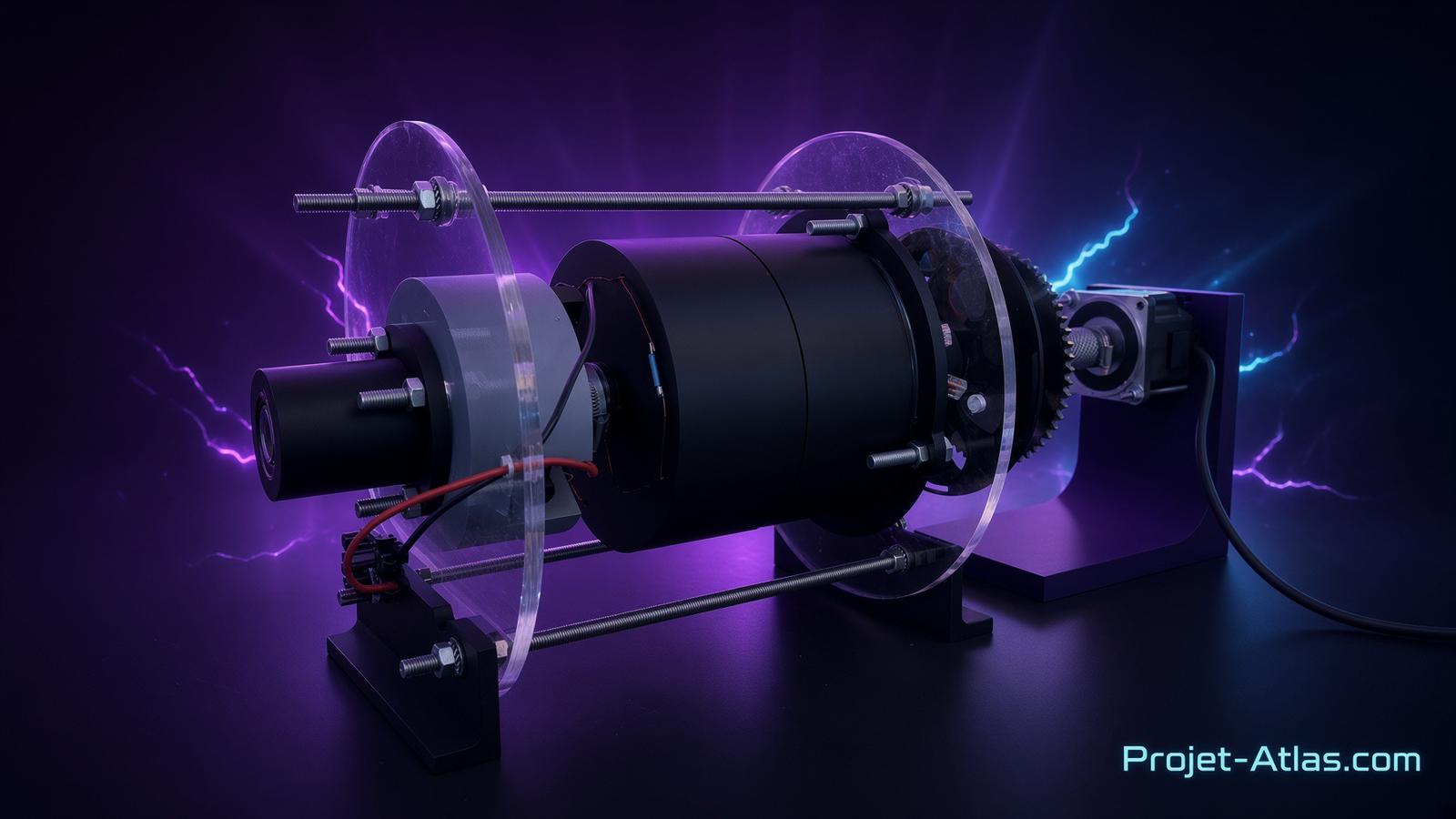
A large share of the objections we received focused on one precise point: the difference between free rotation and real, usable mechanical work. This radial version answers that demand directly. The two cylindrical blocks are the stator and the rotor, each fitted with the neodymium permanent-magnet-core electromagnets described in the publication — the same superposition-cancellation architecture, but assembled radially rather than linearly. The active elements are brought closer together in a smaller volume, for a higher power density. The drive is coupled to an external servo motor through a gear train: speed becomes adjustable, controllable to suit the measurement or the demonstration.
Technical data
| Power | 500 W at the shaft (net) |
|---|---|
| Topology | Radial motor — stator + rotor with neodymium-core electromagnets |
| Rotor | 3D-printed PLA, steel shaft |
| Rotating contact | Carbon brushes |
| Drive | Integrated resonant Class E circuit |
| Actuation | External servo motor, gear transmission, adjustable speed |
| Measurements | Accessible measurement points (oscilloscope); torque on a Prony brake |
| Status | Prototype, patent filed (INPI) |
| Audience | Informed users: basic electronics and practice with measuring instruments |
What this motor shows
- No detectable back-EMF, under all test conditions carried out.
- Net positive torque observed on a Prony brake.
- Reduced consumption of the drive motor in pulsed mode.
- Accessible measurement points to verify it yourself with an oscilloscope.
An energy surplus was observed during bench tests (balance: 200 J injected → 160 J Joule losses + 40 J recovered, with ~40 J of kinetic energy measured independently). On this motor, the mechanical energy at the shaft comes from the “free” torque supplied by magnet repulsion once the circuit is open. This is a real observation, documented in the publication. But a rigorous energy balance of the complete system, confirmed by an independent third party, remains work in progress — not a definitively established result. This motor is designed precisely to observe both sides of the subject: the absence of braking, measured, and the question of the overall gain, still open.
How ordering works
- You place your order onlineCustomer account or guest checkout: you do not need to be a member of the association to buy a motor.
- You pay by bank transferThe bank details (Revolut) are shown at the end of checkout and in the confirmation e-mail. Put your order number as the transfer reference.
- The transfer confirms the orderOn receipt of the transfer, your order enters the production queue: each motor is assembled and tested one by one — allow 2 to 3 months at most for the first units (supplier lead times, volunteer time, contingencies). We tell you your position and the expected collection date.
- You receive your motorYour choice at checkout: free collection at the warehouse (5 rue Hyacinthe Montaudon, 23300 La Souterraine (Creuse, France), by appointment, with a demonstration and handover of the running motor) or home delivery (€100 in France and neighbouring countries, €150 in the UK).
This motor is sold for educational and experimental use only: it is meant to study and observe the implementation of the principle described in the scientific publication. It is not designed for real-world use nor for integration into any system, equipment or production. It is intended for informed users (basic electronics, practice with measuring instruments). Faraday Labs, the Projet Atlas association and the designer decline all responsibility for any use outside this scope. The buyer takes possession of the object knowingly and at their own risk.
Want to understand in detail?
The motor implements the principle described in the two open-access publications: the “InfiniX for Dummies” guide (16 pages, no equation before chapter 10) and the full scientific publication with protocol and measurements.
Go further with the InfiniX motors
Two educational motors to put the principle in your hands, the demonstrator plans for members, and the articles that explain everything.
The motors, to order
The articles

Laboratory inauguration & open day — 14 November 2026
On Friday 14 November 2026, ATLAS officially inaugurates its laboratory: live demonstration of the InfiniX motor on the measurement bench,…
Read the article →
The InfiniX motors: from the linear demonstrator to the radial motor, the complete guide
Two educational motors to verify InfiniX yourself: the linear demonstrator (plans reserved for members) and the radial motor with measurable…
Read the article →Verify it yourself: the plans of the InfiniX educational demonstrator are available
The complete plans (STL + PDF) of a simplified linear demonstrator to reproduce and measure the InfiniX principle yourself. Reserved…
Read the article →Plans of the InfiniX linear demonstrator: STL files and build PDF
Members only: download the STL files of every part and the build PDF of the InfiniX linear educational demonstrator, to…
Read the article →InfiniX goes radial: more compact, more powerful, measurable torque
The next step after the linear demonstrator: a 500 W radial motor at the shaft, net torque measured on a…
Read the article →
InfiniX, the Talk: What Was Actually Said on 18 July
A recap of the InfiniX talk on 18 July 2026 at Faraday Labs: the full video, a step-by-step explanation of…
Read the article →
InfiniX: Christophe Tétard answers your questions and comments
Fascination, scepticism, technical criticism… In this NEXUS magazine video, Christophe Tétard answers the main questions raised by his InfiniX motor…
Read the article →